

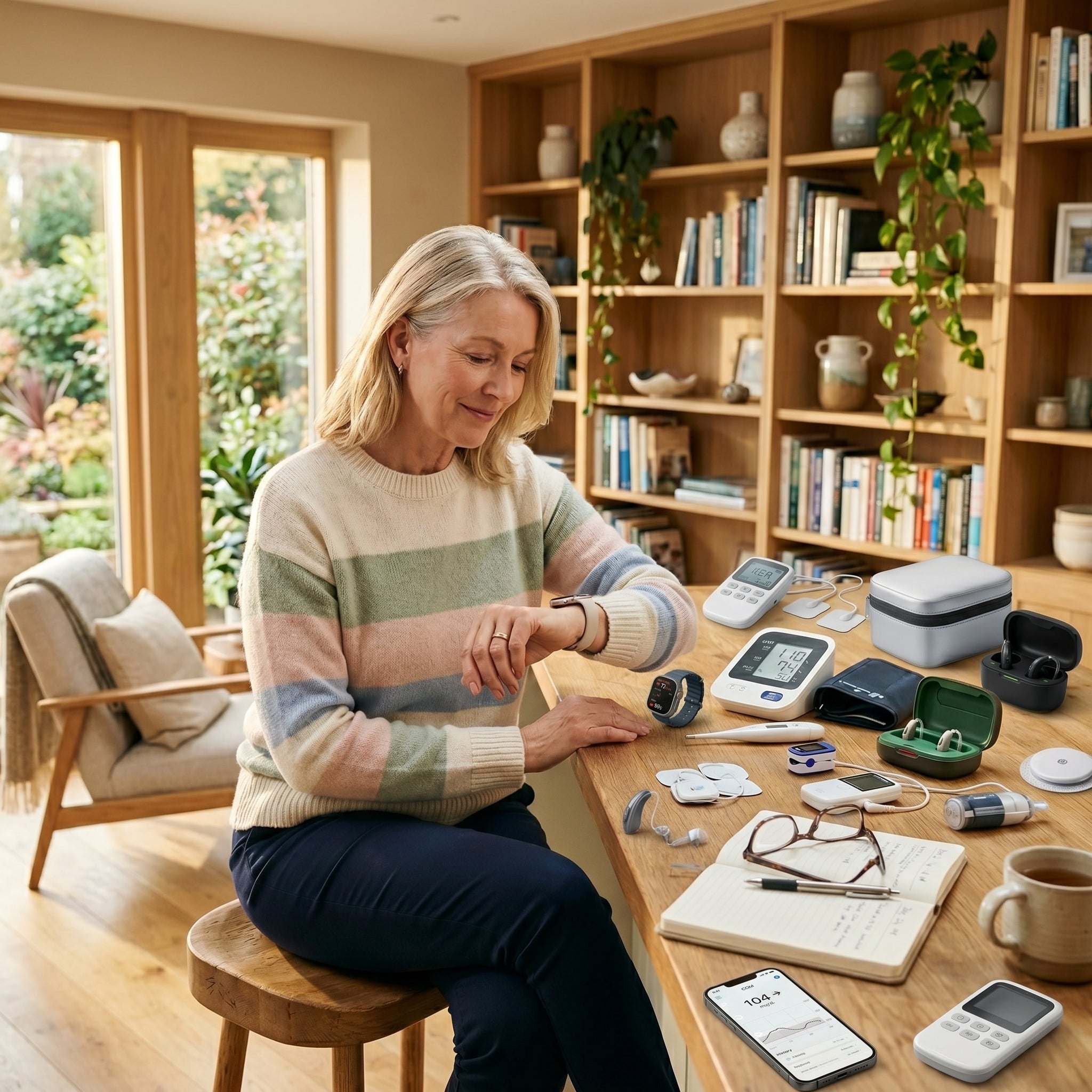
Looking for health monitoring devices NZ households can rely on? This guide explains the 10 most popular at-home health monitoring devices NZ shoppers can buy without a prescription: CGMs, blood pressure monitors, Bluetooth ECG monitors, clinical-grade Holter ECGs, pulse oximeters, smart watches, thermometers, hearing amplifiers, TENS pain relief devices, and portable insulin refrigerators.
None of these devices require a prescription, most cost under $200, and all can be shipped directly to your home anywhere in New Zealand.
If you already know what you need, browse our Health Monitoring Devices collection. If you’re comparing options, this guide will help you choose the right device for your situation.
What are health monitoring devices NZ households can use at home?
Health monitoring devices NZ consumers can buy at home are over-the-counter electronics that measure personal health metrics such as blood pressure, blood glucose, heart rhythm, blood oxygen, and body temperature — without a clinic visit or a prescription. Most are simple enough for daily home use and don’t require any medical training to operate.
They’re not substitutes for hospital equipment, but the gap has narrowed considerably: many at-home devices now use the same sensor technology as their clinical counterparts, just packaged for self-use. In New Zealand, most consumer health monitoring devices are sold over the counter and regulated under the Therapeutic Products Act 2023, with oversight from Medsafe to ensure basic safety and labelling standards.
Why is home health monitoring growing in New Zealand?
Three forces are converging to make health monitoring devices NZ households now treat as standard equipment rather than specialist gear.
Chronic conditions are getting more common. The Heart Foundation reports more than 180,000 New Zealanders are living with heart failure or atrial fibrillation, and Diabetes NZ estimates over 290,000 New Zealanders have diabetes.
Technology has also become far more affordable. A continuous glucose monitor that cost a four-figure sum five years ago is now under $100. A wearable ECG that once needed hospital training to interpret now runs free AI analysis on your phone.
And many people who learned to monitor their own oxygen levels at home during the pandemic haven’t gone back to clinic-only health management. The Heart Foundation’s own home-monitoring guidance for hypertension is now standard public health advice in NZ.
The 10 main types of at-home health monitoring devices
There are 10 main types of health monitoring devices available in New Zealand. Each measures a different metric and suits a different person.
1. Continuous glucose monitors (CGMs)
A continuous glucose monitor (CGM) is a small wearable sensor, usually applied to the upper arm, that continuously tracks glucose levels throughout the day and night. Unlike a finger-prick meter that gives a single reading once or twice a day, a CGM measures glucose levels every minute or two and sends results to a smartphone app, giving a much clearer picture of how food, sleep, exercise, and stress affect blood sugar.
Best for:
• Type 1 diabetes
• Type 2 diabetes
• Gestational diabetes
• Tracking glucose trends and lifestyle impacts
Most modern CGMs are factory-calibrated, waterproof (IP68), and applied at home in under a minute. Sensor wear time is the biggest cost driver — a 15-day sensor halves the per-day cost of a 7-day system. If you don’t have a diagnosed condition, Diabetes NZ recommends discussing readings with a healthcare professional.
2. Blood pressure monitors
A blood pressure monitor measures systolic pressure, diastolic pressure, and pulse rate using an inflatable upper-arm cuff. The Heart Foundation NZ recommends home BP monitoring for anyone managing hypertension, and modern at-home models are accurate enough that daily home readings are considered clinically reliable.
Best for:
• High blood pressure monitoring
• Adults over 50 doing routine wellness tracking
• General heart health tracking
• Multi-user households (look for dual-user memory)
Most digital monitors take readings in under a minute. Voice-guided models with tricolour result indicators (green / orange / red) are especially useful for older household members reading their own results.
3. Consumer Bluetooth ECG monitors
A Bluetooth ECG monitor records the electrical activity of the heart, not just the beats per minute but the full waveform that reveals patterns simple heart-rate tracking misses, like atrial fibrillation (AFib) and other arrhythmias. Most consumer ECGs run a 30-second or 5-minute spot recording on demand.
Best for:
• Heart rhythm monitoring
• AFib tracking
• Investigating palpitations
• Users wanting more detailed heart data than a fitness watch provides
Most models include Bluetooth app connectivity, AI-assisted analysis, a built-in OLED screen so you can use the device without a phone, and downloadable PDF reports for sharing with healthcare professionals.
4. Clinical-grade Holter ECG monitors
A 12-lead AI Holter ECG monitor records heart activity continuously over 24 hours or longer using hospital-equivalent lead coverage (LA, RA, LL, V1–V6). Unlike spot-check ECG devices, Holter monitors are designed to capture intermittent heart events that may not appear during short recordings.
Best for:
• Extended heart rhythm monitoring (24h+)
• Investigating intermittent palpitations
• Dizziness investigations recommended by your GP
• Long-term arrhythmia tracking
Many advanced models include AI-powered desktop software (such as the Viatom AI engine, trained on 300,000 patients) that generates detailed PDF reports covering up to 17 abnormal event types for review or sharing with a healthcare professional. Look for FDA, CE, and NMPA certification.
5. Pulse oximeters and blood oxygen monitors
A pulse oximeter measures blood oxygen saturation (SpO₂) and pulse rate using a fingertip sensor. Advanced Bluetooth blood oxygen monitors can also track oxygen levels continuously overnight using wrist-worn or chest-worn sensors and companion apps.
Best for:
• Respiratory monitoring
• Overnight oxygen tracking
• Sleep apnea screening
• Recovery monitoring (post-COVID or post-illness)
• High-altitude travel
Single-reading pulse oximeters give a one-off SpO₂ percentage suitable for occasional checks. Overnight monitors record continuous trends and sync a full session report you can review in the morning or share with a sleep specialist.
6. Smart watches with health monitoring features
A smart watch with health features combines fitness tracking (steps, distance, workouts) with a health sensor stack. Depending on the model, sensors may include heart rate, ECG, SpO₂, sleep stages, body temperature, and sometimes blood pressure or non-invasive glucose readings, all fed continuously into a phone app.
Best for:
• Everyday wellness tracking
• Fitness monitoring
• Sleep tracking
• Users wanting an all-in-one wearable
Accuracy varies by metric. Heart rate and step counting are reliable; spot SpO₂ readings are useful for trends; blood pressure and glucose readings on smart watches should be treated as supplementary, not as replacements for dedicated medical-grade devices.
7. Digital thermometers
Digital thermometers provide fast electronic temperature readings and are now standard household essentials. Modern infrared models read body heat from a few centimetres away in about a second — no contact required.
Best for:
• Families with children
• Fever monitoring
• Everyday household use
• Quick temperature checks
Many models include a dual body+object mode, useful for checking baby formula or bath water with the same device.
8. Hearing amplifiers
A hearing amplifier is a personal sound amplification product that boosts ambient sound — conversation, TV, doorbell — for someone with mild to moderate hearing difficulty. It’s not the same as a clinical hearing aid (fitted by an audiologist after a hearing test), but for many users with age-related hearing changes, an amplifier delivers most of the benefit at a fraction of the cost.
Best for:
• Mild to moderate hearing loss
• TV listening
• Group conversations and meetings
• Older adults exploring hearing support options
Bluetooth noise-cancelling models let you adjust amplification levels and noise profiles directly from a phone app.
9. TENS devices for at-home pain relief
A TENS (Transcutaneous Electrical Nerve Stimulation) device delivers gentle electrical pulses through adhesive pads on the skin to provide muscle and nerve relief. TENS therapy is widely used at home for everyday muscle tension and recovery support, and it’s a long-established at-home technique.
Best for:
• Chronic muscle tension
• Lower back tension
• Post-exercise soreness and recovery
• General musculoskeletal discomfort
Wireless models with four units can treat up to four body areas simultaneously, with multiple therapy modes (acupuncture, shiatsu, flapping, mix-massage) and 10 intensity levels. Reusable gel pads typically last over 50 uses.
Important: Don’t use a TENS device if you have a pacemaker, cochlear implant, or epilepsy, if you’re pregnant, or on broken or irritated skin.
10. Portable insulin refrigerators
A portable insulin refrigerator is a battery-powered cool box that maintains insulin and other temperature-sensitive medications at the right storage range (typically 0–18°C) wherever you go. While not strictly a monitoring device, it sits within the same diabetes-management toolkit as a CGM.
Best for:
• Travel and holidays
• Daily work commutes
• Outdoor activities and tramping
• Extended periods away from refrigeration
An internal lithium battery (typically 13,600 mAh) keeps the cooler running for 8–10 hours at 4–8°C. Most models accept household, car USB, power bank, or built-in battery power, and are flight-approved as carry-on.
Comparison: which device measures what?
Here’s a quick comparison of the 10 most popular at-home health monitoring devices in New Zealand, including what each measures, how readings are taken, whether an app is required, and the typical price range.
|
Device type |
What it measures |
Reading mode |
Rx? |
App? |
Indicative price (NZD) |
|
Continuous glucose monitor |
Glucose levels (interstitial) |
Continuous, every minute |
No |
Yes |
$79–$150 |
|
Blood pressure monitor |
Systolic, diastolic, pulse |
Spot reading |
No |
No |
$25–$60 |
|
Bluetooth ECG monitor |
Heart rhythm waveform |
30-sec or 5-min sessions |
No |
Optional |
~$130 |
|
12-lead Holter ECG |
Continuous 12-lead ECG |
24h+ continuous |
No |
No (PC software) |
~$600 |
|
Blood oxygen monitor |
SpO₂ + pulse |
Spot or continuous |
No |
Yes |
~$200 |
|
Smart watch health monitor |
ECG, SpO₂, HR, BP, temp, sleep |
Continuous wear |
No |
Yes |
~$80 |
|
Digital thermometer |
Body & object temperature |
1-second contact-free reading |
No |
No |
~$10 |
|
Hearing amplifier |
Sound amplification |
Continuous while worn |
No |
Optional |
$120–$230 |
|
TENS device |
Therapy delivery |
User-controlled session |
No |
No |
~$100 |
|
Portable insulin refrigerator |
Medication temperature control |
Continuous, 0–18°C |
No |
No |
~$130 |
What patterns should you notice?
Two key patterns stand out when comparing health monitoring devices NZ-wide.
First, none of these devices require a prescription in New Zealand — they’re all sold over the counter and ship directly to your address.
Second, simpler spot-reading devices (blood pressure monitors, thermometers, TENS devices) usually work as standalone products without an app. In contrast, devices designed for long-term trend tracking (CGMs, smart watches, ECG monitors, and overnight oxygen monitors) usually rely on smartphone apps or desktop software to unlock their full value through historical data, alerts, and reports.
Do you need a prescription to buy these in New Zealand?
No — none of the at-home health monitoring devices NZ shoppers can buy in this guide require a prescription. They’re sold over the counter and ship directly to your home address.
The exception is interpretation. While you don’t need a prescription to buy a CGM or an ECG, you may want a clinical conversation about what the readings mean — particularly for cardiac devices like the 12-lead Holter ECG, which is designed to feed data back to your doctor for review. The device collects the data; your doctor helps interpret what it means.
How do you choose the right health monitoring device?
Choosing the right device gets much easier once you focus on what you actually need to track. Use the Four-Question Health-Device Framework to shortlist your device in under five minutes.
1. What health metric do you want to monitor?
Start with the metric, not the device:
• Blood glucose → Continuous glucose monitor (CGM)
• Blood pressure → Blood pressure monitor
• Heart rhythm → Bluetooth ECG monitor or Holter ECG
• Blood oxygen → Pulse oximeter
• General wellness → Smart watch
Focusing on the metric helps avoid buying features you may never use.
2. Do you need spot readings or continuous monitoring?
Some devices give a quick snapshot; others track trends over time.
Spot-reading devices:
• Blood pressure monitors
• Thermometers
• Finger pulse oximeters
Continuous monitoring devices:
• CGMs
• Holter ECG monitors
• Overnight oxygen monitors
• Smart watches
Continuous monitoring gives richer long-term trend data but costs more and needs more setup.
3. Do you want a standalone device or app connectivity?
Standalone devices are often simpler for less tech-confident users.
Good standalone options:
• Blood pressure monitors
• Thermometers
• TENS devices
• Hearing amplifiers
App-connected devices unlock more value:
• CGMs
• Smart watches
• Bluetooth ECG monitors
• Blood oxygen monitors
4. Are you buying for yourself or a family member?
The best device often depends on who will actually use it daily.
For older family members, prioritise:
• Large displays
• Simple buttons
• Voice guidance
• No-app operation
For personal wellness tracking, app-connected devices with richer data tend to deliver a better experience.
Answer these four questions and your shortlist falls out. Browse our full health monitoring devices range to compare features and find the right fit.
Where can you buy health monitoring devices NZ-wide?
Health Marketplace NZ stocks all 10 device categories in this guide, combining well-known NZ and AU wellness brands (Blackmores, Comvita, MitoQ, Manuka Health, Swisse) with our own affordable monitoring device range.
Our health monitoring devices NZ-wide range includes:
• Continuous glucose monitors (CGMs)
• Blood pressure monitors
• Bluetooth ECG and 12-lead Holter ECG monitors
• Pulse oximeters and blood oxygen monitors
• Smart health watches
• Digital thermometers
• Hearing amplifiers
• TENS pain relief devices
• Portable insulin refrigerators
The hero product in our range is the LinX 15-Day CGM — one of the most accessible direct-to-consumer continuous glucose monitors available in New Zealand, with 15-day sensor wear time that halves the per-day cost compared to 7-day systems.
Orders are dispatched locally within 1–2 business days, with free shipping on NZ orders over $79.
Frequently asked questions
How accurate are at-home CGMs compared to a finger-prick meter?
Modern continuous glucose monitors typically have a mean absolute relative difference (MARD) under 10% versus laboratory blood testing, making them accurate enough for everyday glucose tracking. They measure interstitial glucose rather than blood glucose, so readings can lag actual blood values by 5–10 minutes during rapid changes such as after meals or exercise. This small lag is normal and explains why CGM readings may not always match a finger-prick reading exactly.
Are home blood pressure monitors accurate?
Yes — validated upper-arm cuff monitors are widely used by clinicians and considered reliable when used correctly. For the most accurate reading: sit with your back supported, keep your feet flat on the floor, position your arm at heart level, and avoid caffeine, smoking, or exercise for at least 30 minutes before testing. Taking readings at the same time each day improves consistency.
How long do CGM sensors last?
CGM sensor wear time depends on the model, but most modern systems last between 7 and 15 days per sensor. A 15-day sensor lasts roughly twice as long as a 7-day sensor before replacement is required, which halves the per-day cost. Most modern CGMs are factory-calibrated, so finger-prick calibration is generally not needed during normal use.
Can a smart watch really monitor health?
Smart watches are useful for tracking general health and wellness trends — heart rate, activity levels, sleep patterns, blood oxygen trends, and ECG readings on supported models. Accuracy varies by device and feature. Smart watches are best treated as wellness and trend-monitoring tools rather than replacements for dedicated medical-grade devices. For critical measurements like blood pressure or glucose monitoring, dedicated health devices remain the more reliable option.
Do I need a smartphone to use these devices?
Not always. Many health monitoring devices NZ shoppers can buy work completely standalone, including blood pressure monitors, digital thermometers, TENS devices, hearing amplifiers, and portable insulin refrigerators. Devices designed for long-term trend tracking — CGMs, smart watches, Bluetooth ECG monitors, and blood oxygen monitors — usually rely on smartphone apps for full functionality, including historical data, alerts, trend analysis, and downloadable reports.
Where can I buy these in NZ?
Health Marketplace NZ’s health monitoring devices collection stocks all 10 device categories with NZ-based support and free shipping over $79.
A practical next step
If you’re new to at-home health monitoring, start with the single metric most relevant to your household:
• Blood pressure monitoring for adults over 50
• Glucose monitoring for diabetes or pre-diabetes
• Heart rhythm tracking for palpitations or family history of AFib
Rather than buying several devices at once, focus on building a consistent habit with one. The biggest mistake people make with home health monitoring isn’t choosing the wrong device — it’s buying five and abandoning all of them. One device used daily beats five sitting in a drawer.
When you’re ready, browse the full Health Monitoring Devices range — 10 device categories, NZ-based support, and free shipping over $79.


