

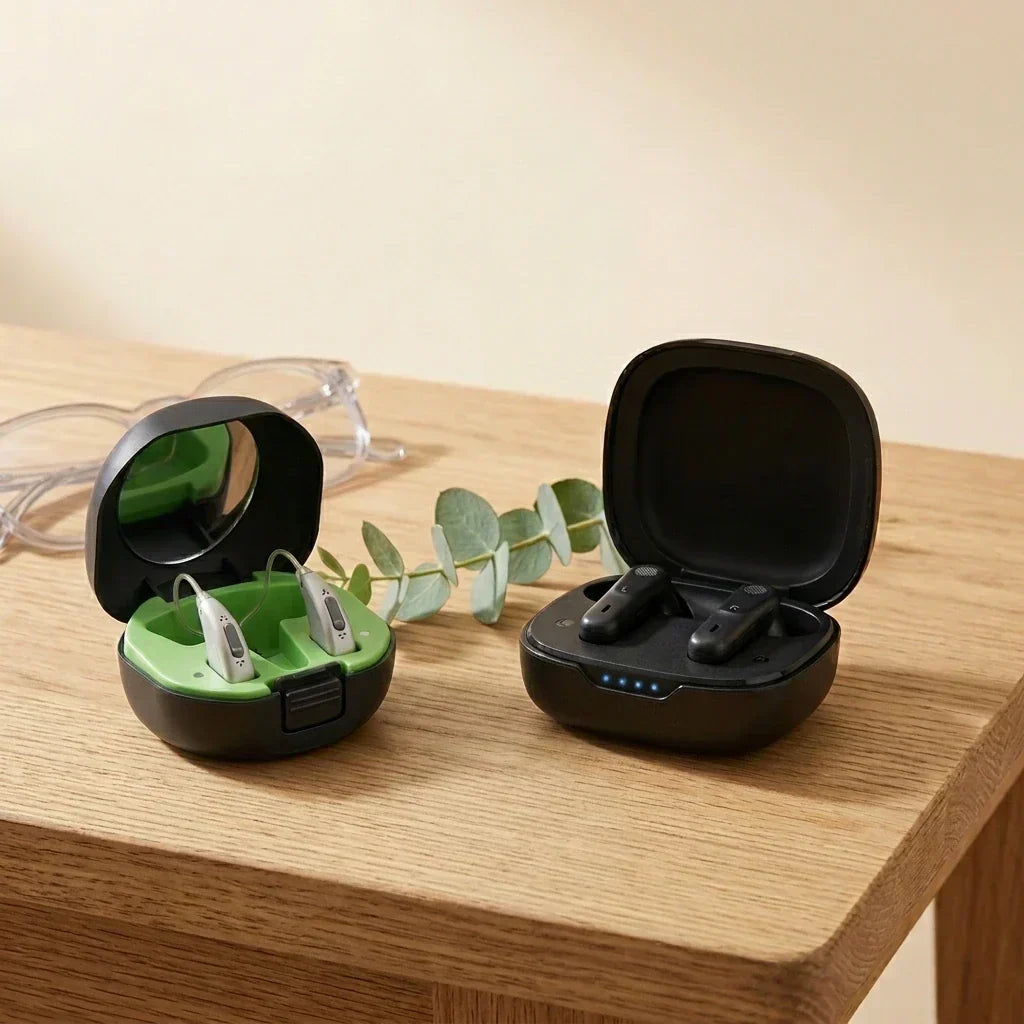
If you've started looking for a device to help you hear better, you've probably come across two common terms: hearing aids and hearing amplifiers. At first glance, they can look almost identical. They often fit in the ear in a similar way, and in some cases they even cost a similar amount. Despite their similarities, they serve different purposes.
A hearing amplifier increases the volume of all sounds, making everything around you louder. A hearing aid, on the other hand, is designed to amplify specific sounds and frequencies based on an individual's hearing needs — helping make speech clearer while providing a more personalised listening experience.
Understanding the difference between the two can make it much easier to choose the right device. It can also help you avoid paying for features you don't need — or missing out on features that could make a real difference to your hearing. Here's a plain-language guide, written for a New Zealand audience.
The quick answer
● Hearing amplifier — a simple device with a microphone, amplifier and small speaker that makes all sounds louder. Best suited to occasional listening situations or mild hearing difficulty, where a little extra volume is all that's needed.
● Hearing aid — a more advanced device that processes sound across different frequencies, amplifying the sounds you find harder to hear while keeping other sounds balanced. Designed for everyday use by people with mild to moderate hearing loss.
● The overlap — modern rechargeable devices have blurred the line between the two. Some hearing amplifiers now include features such as digital noise reduction, while some hearing aids are simple enough to set up and adjust at home. Rather than focusing solely on the label, consider how the device processes sound and whether it meets your hearing needs.
What is a hearing amplifier?
A hearing amplifier — sometimes called a personal sound amplification product (PSAP) — is the simpler of the two devices. At its core, it has three main components: a microphone that picks up sound, an amplifier that increases the volume, and a small speaker that delivers the sound into your ear.
The key difference is that a basic hearing amplifier makes all sounds louder. It doesn't distinguish between the conversation you want to hear and the background noise around you — traffic, air conditioning or the hum of a refrigerator — it amplifies both.
Originally, PSAPs were designed for people with normal hearing who wanted extra volume in specific situations, such as listening to a quiet speaker at the back of a room, watching television at a lower volume without disturbing others, or enjoying birdsong while out walking.
That doesn't mean they're only useful for people with normal hearing. For someone who experiences occasional or mild hearing difficulty, a quality hearing amplifier can be an affordable and practical first step. Some modern models also include features such as digital noise reduction, which can help make listening more comfortable in certain environments. Their primary purpose, however, is still to increase overall volume rather than tailor sound to an individual's hearing needs.
What is a hearing aid?
A hearing aid is designed to do more than simply make sounds louder. Instead, it processes sound across different frequencies, allowing it to amplify the sounds you have more difficulty hearing while keeping other sounds more balanced. This approach can make speech clearer and provide a more natural listening experience.
A simple way to think about it is this: a hearing amplifier is like turning up the volume on your television, while a hearing aid is more like adjusting the equaliser — increasing certain frequencies while leaving others largely unchanged.
Many hearing aids also include features that improve listening comfort, such as background noise reduction, feedback management (to reduce whistling), and automatic or manual listening modes for different environments — quiet rooms, busy cafés, television and phone calls. Many rechargeable models also connect to a smartphone app, allowing users to adjust volume, listening modes and other settings.
Traditionally, hearing aids have been fitted and programmed by an audiologist using the results of a hearing assessment, and this remains the standard approach for many people. More recently, however, over-the-counter (OTC) hearing aids have become available in some countries, allowing adults with perceived mild to moderate hearing loss to purchase and set up certain hearing aids themselves, without an in-person appointment.
Hearing aid vs amplifier: side by side
|
|
Hearing amplifier |
Hearing aid |
|
What it does |
Makes all sound louder |
Lifts specific frequencies, shaped to your hearing |
|
Sound processing |
Basic; single overall volume |
Multi-channel; balances pitches and reduces noise |
|
Best suited to |
Occasional listening, mild difficulty |
Ongoing everyday use, mild to moderate hearing loss |
|
Fitting |
Wear straight away; simple controls |
Self-fitting (OTC) or professionally programmed |
|
App control |
Usually none |
Often, on Bluetooth models |
|
Typical cost |
Lower |
Higher, but still a fraction of clinic-fitted devices |
|
Not designed for |
Treating diagnosed hearing loss |
Severe or profound hearing loss (see a professional) |
Where do over-the-counter hearing aids fit in New Zealand?
New Zealand's approach is a little different from what you may read on overseas websites. In the United States, the Food and Drug Administration (FDA) created a formal category for over-the-counter (OTC) hearing aids, with specific regulations for adults with perceived mild to moderate hearing loss.
New Zealand does not have an equivalent OTC hearing aid category. Instead, hearing aids are regulated as medical devices, with oversight by Medsafe. Unlike the US system, Medsafe does not operate a pre-market approval programme for most medical devices — suppliers are generally responsible for ensuring their products meet New Zealand's regulatory requirements before they are supplied.
In practice, this means New Zealand consumers can purchase hearing devices online or directly from retailers, ranging from simple hearing amplifiers to self-fitting hearing aids intended for adults with mild to moderate hearing loss.
The New Zealand Audiological Society acknowledges that self-fitting hearing aids can provide a more affordable and convenient option for some adults with mild to moderate hearing loss. At the same time, it recommends seeking advice from a qualified audiologist or audiometrist if you're unsure about the cause or extent of your hearing loss, or if your hearing changes suddenly.
It's also worth remembering that hearing devices sold by New Zealand retailers are covered by the Consumer Guarantees Act 1993. That means they must be of acceptable quality, fit for their intended purpose, and match their description. When comparing products, buying from a reputable New Zealand retailer can provide greater confidence and access to local consumer protections.
Which one is right for you?
Rather than starting with the label on the box, start with your own hearing experience. Asking yourself a few simple questions can help you choose the device that's most likely to meet your needs.
● How often do you notice hearing difficulty? If it's only in the occasional situation — such as chatting with a softly spoken friend or turning up the television a little — a hearing amplifier may be enough. If you're regularly asking people to repeat themselves or struggling to hear conversations, a hearing aid is likely to provide greater benefit.
● Where do you find hearing most difficult? If your biggest challenge is following conversations in busy cafés, restaurants or group settings, simply increasing the volume may not be enough. A hearing aid that can enhance speech while helping manage background noise is generally a better choice.
● Do you want to adjust your device yourself? Many modern hearing aids connect to a smartphone app, allowing you to adjust volume, listening modes and other settings. If these features are important to you, look for a rechargeable, Bluetooth-enabled hearing aid rather than a basic hearing amplifier.
● What's your budget, and how often will you use it? A hearing amplifier can be an affordable way to improve hearing in occasional situations. If you need support throughout the day, investing in a rechargeable hearing aid may provide a more comfortable and effective long-term solution.
As a general guide, people with occasional or mild hearing difficulty may find that a quality hearing amplifier meets their needs. Those with ongoing mild to moderate hearing loss — especially if they struggle to understand speech in noisy environments — will often benefit more from a hearing aid designed to process sound across different frequencies. Whichever option you choose, many modern rechargeable devices offer the convenience of charging overnight in a compact case, doing away with tiny disposable batteries.
A note on funding
If you're comparing hearing devices in New Zealand, it's helpful to understand how government funding works, as it can influence both the purchase process and the overall cost.
For eligible New Zealand residents aged 16 and over, the Government's hearing aid subsidy provides $511.11 per hearing aid (up to $1,022.22 for a pair) once every six years. Additional support may also be available through the Hearing Aid Funding Scheme for people who meet specific eligibility criteria, while ACC may contribute if hearing loss is related to an injury or workplace noise exposure.
The funding pathway is an important consideration. In most cases, claiming government funding requires your hearing aids to be assessed, fitted and supplied through an approved hearing care professional, with the devices meeting the relevant programme requirements.
If you choose to purchase a hearing amplifier or a self-fitting hearing aid directly online, you are generally outside that funded pathway. While this means government funding typically isn't available, it also allows you to avoid appointment costs and often results in a lower upfront purchase price. For many people with occasional or mild hearing difficulties, buying directly can be a practical and cost-effective option. However, if you think you may qualify for government assistance — or if you're unsure which option is right for you — it's worth speaking with an audiologist or audiometrist before making a decision.
Funding amounts and eligibility criteria can change over time. Check the latest details with Disability Support Services or Enable New Zealand before making a decision.
When to see a hearing professional
A hearing amplifier or self-fitting hearing aid can be a practical solution for many people, but they aren't the right choice for every situation. It's important to know when professional advice is the better option. Arrange a hearing assessment with an audiologist or audiometrist if:
● your hearing loss is significant, develops suddenly, or affects one ear much more than the other;
● you have ear pain, discharge, persistent ringing in the ears (tinnitus), dizziness, or a feeling of fullness or blockage in your ear;
● you've tried a hearing device but it isn't improving your hearing or communication.
Some causes of hearing loss — such as a build-up of earwax — can often be treated easily, while others may require medical assessment. People with severe or profound hearing loss are also likely to benefit from professionally fitted hearing aids or other hearing solutions, rather than a hearing amplifier or self-fitting device. If you're unsure about your hearing, booking a hearing assessment is a sensible first step. Many hearing care providers in New Zealand offer free initial hearing checks, making it easy to better understand your hearing before deciding on a device.
Frequently asked questions
Is a hearing amplifier the same as a hearing aid?
No. A hearing amplifier increases the volume of all sounds, while a hearing aid processes sound across different frequencies to provide more targeted amplification. Although they may look similar, they're designed for different purposes.
Can I use a hearing amplifier instead of a hearing aid?
It depends on your hearing needs. If you only experience occasional or mild hearing difficulty, a hearing amplifier may provide enough extra volume in certain situations. If you regularly struggle to follow conversations — particularly in noisy environments — a hearing aid will generally offer better speech clarity and a more natural listening experience.
Do I need a prescription to buy a hearing aid in New Zealand?
No. In New Zealand, you can purchase hearing amplifiers and many self-fitting hearing aids directly from retailers without a referral or prescription. However, if you're unsure about the cause or severity of your hearing loss, it's a good idea to have your hearing assessed by an audiologist or audiometrist before choosing a device.
Are cheaper hearing devices any good?
Price doesn't always determine how well a device will work for you. A well-designed hearing amplifier or self-fitting hearing aid can be an effective solution for the right person. The most important factor is choosing a device that matches your hearing needs, lifestyle and budget, rather than simply selecting the most expensive option.
Finding the right fit
The key takeaway is simple: there isn't one device that's better than the other — only the one that's better suited to your hearing needs.
If you only need occasional extra volume, a rechargeable hearing amplifier may be all you need. If you want clearer conversations, more personalised sound and features such as Bluetooth connectivity, app control and different listening modes, a rechargeable hearing aid designed for mild to moderate hearing loss is likely to be the better choice for everyday use.
Whether you're looking for a simple hearing amplifier or a feature-rich hearing aid, choosing a device that matches your lifestyle and level of hearing difficulty will give you the best experience. Explore our range of rechargeable hearing aids and hearing amplifiers to compare your options — every model is rechargeable, ready to wear, and includes free NZ shipping on orders over $79. And if you're unsure which device is right for you, a hearing assessment with a local audiologist or audiometrist can help you make a more informed decision.
Please note: This article is general information about hearing devices only and should not be considered medical advice. It isn't a substitute for a professional hearing assessment. If you have any concerns about your hearing, please see a qualified audiologist or audiometrist.


