

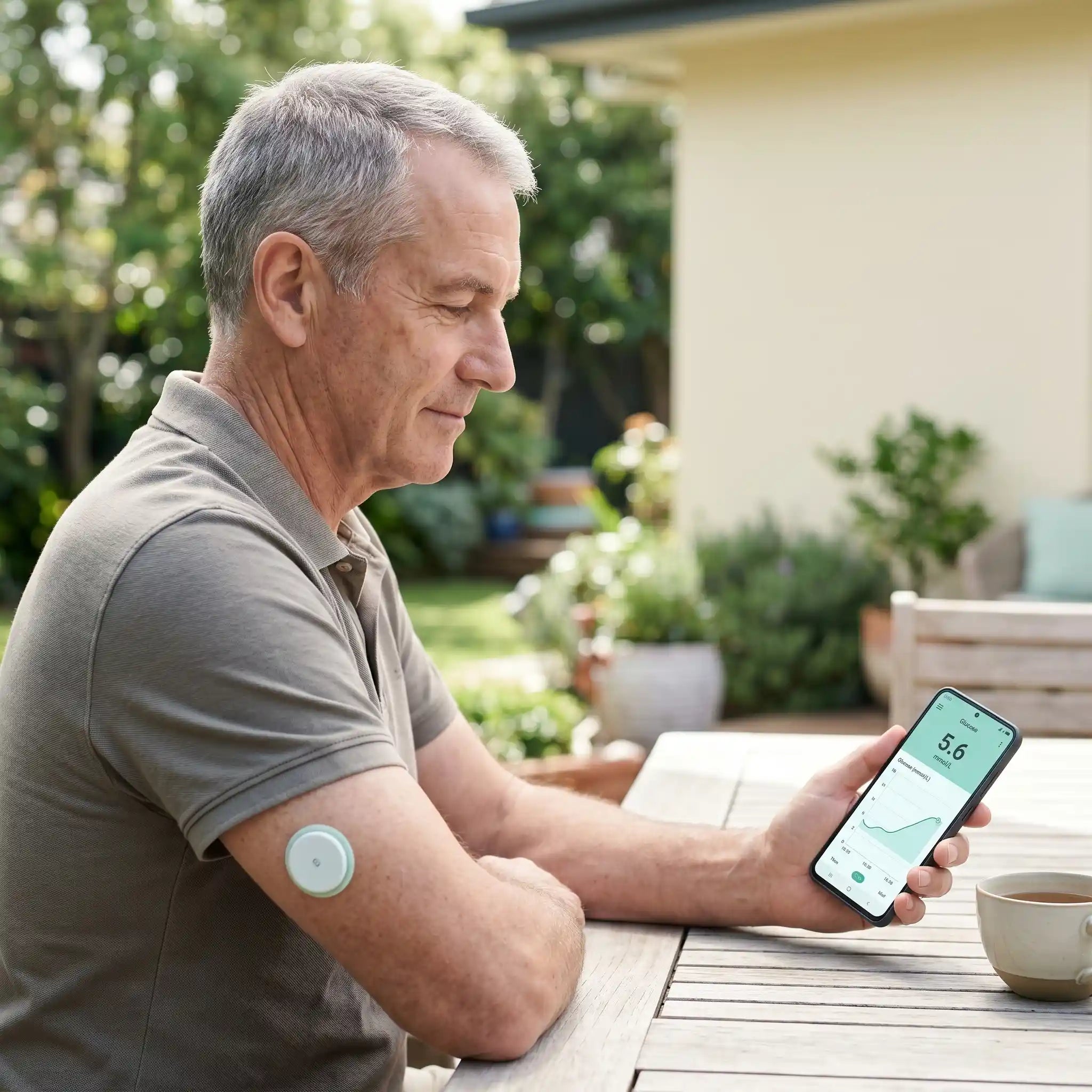
A continuous glucose monitor (CGM) doesn't measure the glucose in your blood directly. Instead, it measures glucose in the interstitial fluid — the thin layer of fluid that sits between the cells just beneath your skin — and uses that information to estimate your blood glucose level.
A small sensor worn on the upper arm takes readings automatically throughout the day and night, often as frequently as once per minute, with no finger-prick testing required for routine use. Continuous glucose monitoring provides a near-continuous picture of where your glucose is now, which direction it's heading, and how it responds to meals, exercise, sleep, and daily routines.
In New Zealand, CGM technology is becoming increasingly accessible, making it easier than ever to monitor glucose trends in real time.
What a CGM Measures: Interstitial Fluid Glucose, Not Blood
A CGM — sometimes called a continuous blood glucose monitor or continuous blood sugar monitor — measures glucose in interstitial fluid rather than directly in the bloodstream.
Interstitial fluid is the fluid that surrounds and nourishes your body's cells, occupying the space just beneath the skin. A tiny, flexible filament, much thinner than a needle, sits a few millimetres below the skin's surface and measures the glucose dissolved within this fluid.
Because the sensor sits in the interstitial space rather than a blood vessel, there's no need for continuous blood sampling. This is what allows the device to remain comfortably in place and provide readings around the clock for days at a time.
Understanding this distinction is key to understanding how a CGM works. Every reading displayed in the app is a measurement of interstitial glucose that has been converted into an estimate of blood glucose. The two measurements are closely related, but they are not identical — and that difference becomes important when glucose levels are changing quickly.
How Does a CGM Turn Glucose Into a Reading?
CGM sensors use a specialised enzyme that reacts with glucose to produce a tiny electrical current. The strength of that current is proportional to the amount of glucose present.
Most modern sensors use an enzyme called glucose oxidase, which coats a small electrode on the sensor filament. When glucose in the interstitial fluid comes into contact with the enzyme, a chemical reaction generates an electrical signal. The higher the glucose concentration, the stronger the signal.
The sensor's electronics then convert that signal into a glucose reading, which is transmitted wirelessly to a smartphone app.
On modern all-in-one systems such as the LinX 15-Day CGM, readings are transmitted automatically via Bluetooth once per minute, 24 hours a day, without the need to scan the sensor. These systems are factory-calibrated, meaning users do not need to perform routine finger-prick calibrations. After applying the sensor and pairing it with the app, readings are delivered automatically throughout the wear period.
Is Interstitial Glucose the Same as Blood Glucose?
Interstitial glucose closely follows blood glucose, but it is not exactly the same. Because glucose must move from the bloodstream into the surrounding interstitial fluid before it can be measured, CGM readings can lag behind blood glucose by approximately 10–15 minutes when glucose levels are changing rapidly.
When glucose levels are relatively stable, interstitial glucose and blood glucose tend to align very closely. However, after meals, during exercise, or when medication is taking effect, glucose levels may rise or fall quickly. During these periods, the CGM is effectively reporting where blood glucose was a few minutes earlier.
This lag is normal and applies to all CGM systems. In many situations, the trend and direction of change are more useful than any individual reading.
If a sensor reading doesn't match how you feel, most manufacturers recommend confirming the result with a finger-prick blood glucose meter before making treatment decisions.
How Accurate Is a CGM Compared with a Finger-Prick Test?
Modern CGMs are highly accurate. For example, the LinX 15-Day CGM has a MARD (Mean Absolute Relative Difference) of 8.66%. MARD is the standard measure used to assess CGM accuracy and indicates how closely sensor readings align with laboratory blood glucose measurements.
Lower MARD values generally indicate closer agreement between CGM readings and laboratory results, with values below 10% often considered a strong indicator of sensor accuracy.
However, the biggest difference between CGMs and traditional blood glucose meters isn't necessarily accuracy — it's the type of information they provide. A finger-prick blood glucose meter gives a single reading at one moment in time. A CGM provides a continuous stream of readings throughout the day and night, along with trend information that shows whether glucose is rising, falling, or remaining stable.
CGM vs finger-prick meter: what each one measures
| Feature | Continuous glucose monitor (CGM) | Finger-prick meter (BGM) |
|---|---|---|
| What it measures | Glucose in interstitial fluid | Glucose in capillary blood |
| Reading frequency | Automatically, about every minute | One reading per test |
| Shows trends | Yes — direction and rate of change | No — a single snapshot |
| Alerts | High, low and rapid-change alerts | None |
| Finger-pricks | None for routine use | Required for every reading |
| Best used for | A continuous, 24-hour picture | Spot-checking and verification |
How Long Does a Sensor Last, and Where Do You Wear It?
CGM sensors are worn continuously for a fixed period before being replaced. The LinX 15-Day CGM is designed to last for up to 15 days per sensor, meaning a two-pack can provide up to 30 days of monitoring.
The sensor is typically applied to the back of the upper arm using a simple applicator. Once in place, it sits low against the skin and weighs only a few grams, making it easy to wear throughout normal daily activities.
Many modern CGMs are designed to withstand everyday water exposure. The LinX sensor is rated IP68 for dust and water resistance, allowing it to remain in place during showering and routine activities. Additional adhesive tape can be used for swimming, contact sports, or situations where extra security is desired.
Does Wearing a CGM Hurt?
For most people, applying and wearing a CGM involves minimal discomfort. The applicator inserts the sensor filament in a fraction of a second. Because the filament is extremely fine and sits only a few millimetres beneath the skin, many users describe the sensation as a brief pinch or report feeling very little at all.
Once inserted, there is no needle left in the body. The flexible filament remains in the interstitial space, and most users quickly forget the sensor is there.
The sensor is secured using a hypoallergenic adhesive, and many people comfortably wear it for the full sensor life. As with any adhesive product, a small number of users may experience mild skin irritation. Rotating the application site between sensor changes can help minimise this.
What Can You Actually See in CGM Data?
A CGM provides much more than a single glucose number. Most apps display glucose readings as a continuous graph, allowing you to see how levels change throughout the day. Trend arrows indicate whether glucose is rising, falling, or remaining steady, helping provide context for each reading.
Many CGM systems also allow users to set alerts for high glucose levels, low glucose levels, or rapid changes in glucose. Over time, the data can be summarised into useful reports and patterns. One commonly used measure is Time in Range (TIR), which shows the percentage of time glucose levels remain within a target range.
The LinX app can also generate an Ambulatory Glucose Profile (AGP) report, which can be exported, shared through the Pancares portal, or reviewed with healthcare professionals. Live glucose readings can also be shared with family members or caregivers when desired.
This broader view of glucose behaviour is one of the key advantages of CGM technology. Rather than relying on isolated readings, users can see patterns that develop across entire days and weeks.
Who Uses a Continuous Glucose Monitor?
CGMs are used by people who want to understand glucose patterns more comprehensively than is possible with occasional spot checks. Many users live with type 1 or type 2 diabetes and use CGM data to better understand how food, exercise, medication, stress, and daily routines influence their glucose levels.
Others use CGMs to gain insight into their metabolic health, observing how different foods, workouts, sleep patterns, and lifestyle habits affect their glucose responses.
Whatever the reason for using a CGM, the information it provides is intended to support understanding and informed decision-making. It is not a diagnosis, treatment, or substitute for professional medical advice.
Choosing a Continuous Glucose Monitor in New Zealand
When comparing continuous glucose monitors in New Zealand, it's worth considering four key factors:
- Reading frequency
- Sensor lifespan
- Accuracy
- Smartphone compatibility
The LinX 15-Day CGM combines continuous Bluetooth-enabled monitoring, up to 15 days of wear per sensor, a MARD of 8.66%, IP68 water resistance, and compatibility with both Android and Apple devices.
It's also important to consider the ongoing cost of replacement sensors and to confirm that your smartphone supports the manufacturer's app before purchasing.
One point sets this CGM monitor apart in the New Zealand market: it's available without a prescription, unlike some pharmacy-channel options — so you can buy a continuous glucose monitor directly online, whether you're tracking glucose for a diagnosed condition or simply want to understand your own patterns. The single CGM kit covers 15 days, a two-pack covers a full 30 days, and prices start from $79.
Disclaimer: This article is general information only and is not medical advice. Please consult your doctor before making any decisions about diagnosing or managing a health condition.


