

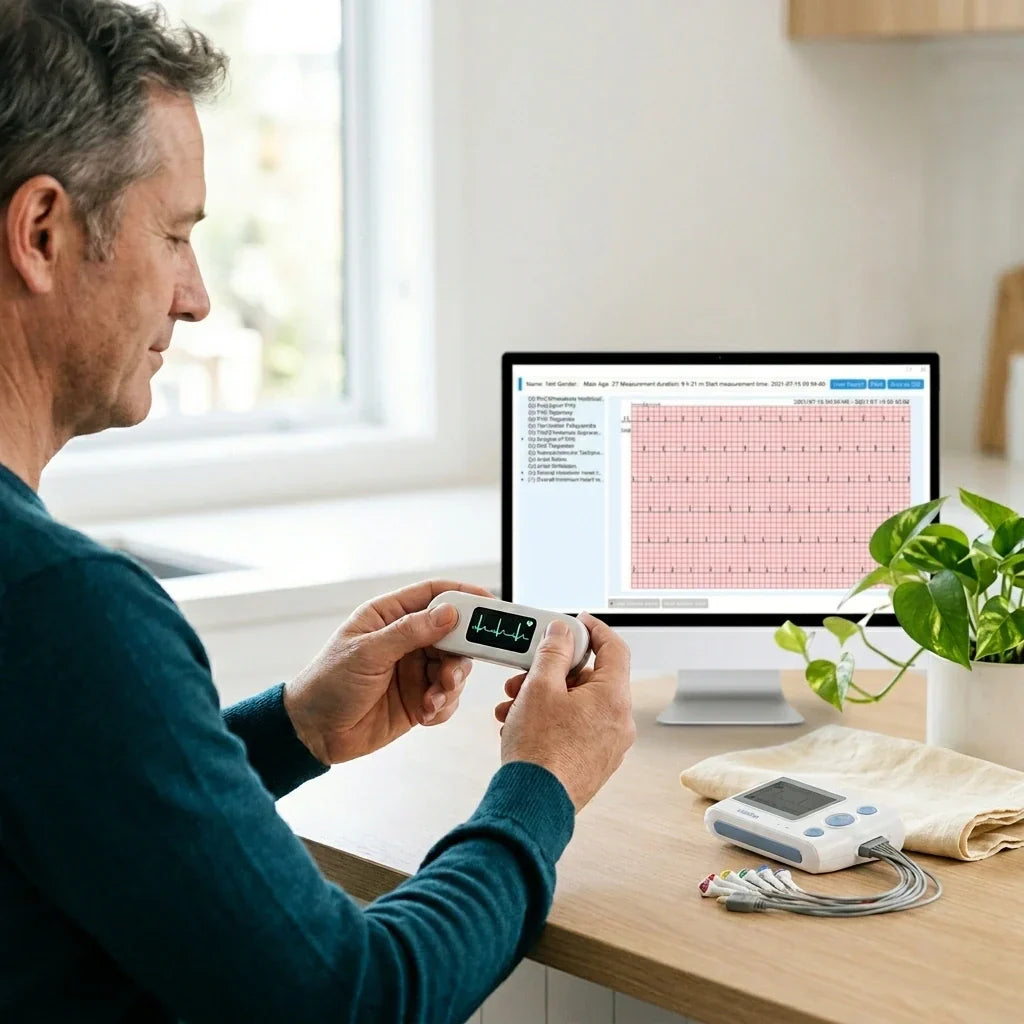
If you’re considering an ECG monitor for home use, one of the first questions you’ll encounter is whether you need a single-lead ECG monitor or a 12-lead ECG monitor.
The answer depends on how you want to record and review your heart rhythm. For most people, a single-lead ECG monitor provides a fast, convenient way to capture a reading in as little as 30 seconds and store it on a smartphone for future reference. A 12-lead Holter monitor, on the other hand, is designed for continuous recording over 24 hours or longer and provides a more comprehensive picture of heart rhythm activity throughout the day.
At Health Marketplace NZ, our most popular option is the Bluetooth ECG Heart Rate Monitor. This compact single-lead ECG monitor allows you to take on-demand ECG recordings at home, view results instantly, and store reports on your smartphone for sharing with healthcare professionals when required.
In this guide, we’ll explain what ECG monitors measure, what “leads” actually mean, how single-lead and 12-lead devices differ, and which option may be best suited to your needs.
What Does an ECG Monitor Measure?
An ECG monitor records the electrical signals your heart produces with each beat and displays them as a waveform. This waveform shows both the rate and rhythm of your heartbeat over the recording period. You may also see these devices referred to as an ECG machine, EKG monitor, heart monitor, health monitor, or portable ECG device. While the terminology varies, they all perform the same core function: recording your heart’s electrical activity.
One common point of confusion is the difference between ECG and EKG. In reality, they are the same test. ECG stands for electrocardiogram, while EKG is derived from the original German spelling, elektrokardiogramm. In New Zealand, ECG is the term most commonly used — and a portable EKG machine and a portable ECG monitor describe exactly the same kind of device.
Another important distinction is the difference between an ECG monitor and a standard heart rate monitor. A basic heart rate monitor — sometimes called a heartbeat monitor — measures how many times your heart beats per minute. An ECG monitor goes a step further by recording the electrical pattern of each heartbeat, allowing you to see the rhythm of your heart rather than just the number of beats.
This is what makes an at-home ECG monitor so valuable. While a fitness tracker or smartwatch may show your pulse rate, an ECG monitor captures a detailed waveform that can be stored, reviewed, and shared. Many modern devices also pair with smartphone apps that organise readings, generate reports, and help you track changes over time.
As home health technology has become more accessible, ECG monitoring is no longer limited to clinics and hospitals. Portable ECG monitors now allow people to record readings whenever they choose, making it easier than ever to monitor heart rhythm from the comfort of home. Understanding how these devices work is the first step towards choosing the option that best suits your needs.
What Do “Leads” Mean on an ECG?
When comparing ECG monitors, one of the first specifications you’ll notice is the number of “leads” a device uses. Despite the name, a lead is not a wire or sensor. Instead, a lead is a different viewpoint of your heart’s electrical activity.
Think of it like taking photos of a building. A single photo only shows one angle, while multiple photos taken from different positions provide a more complete picture. ECG leads work in a similar way. Each lead views your heart’s electrical signals from a slightly different angle, helping to build a clearer understanding of your heart rhythm.
A single-lead ECG monitor records your heart’s electrical activity from one viewpoint. These devices are designed for quick, convenient readings and are ideal for on-demand use at home. Simply place the device, remain still for a short period, and a recording can be completed in as little as 30 seconds.
A 12-lead ECG monitor records the heart’s electrical activity from twelve different viewpoints simultaneously. This provides a more detailed picture of the heart’s rhythm and electrical patterns. When used as a Holter monitor, it can also record continuously for 24 hours or longer, capturing activity throughout your normal daily routine.
For most people, the choice comes down to a simple trade-off: single-lead ECG monitors offer speed, convenience, and portability, while 12-lead ECG monitors provide more detailed recordings and longer monitoring periods. Neither option is inherently better than the other — the right choice depends on how you want to monitor your heart and the level of detail you are looking for.
Single-Lead ECG Monitors: Quick, On-Demand Readings
A single-lead ECG monitor is designed for fast, convenient heart rhythm recordings whenever you want them. Health Marketplace NZ’s Bluetooth ECG Heart Rate Monitor is a compact, handheld device that makes it easy to record ECG readings at home, at work, or while travelling.
Using the device is simple. You can take a quick 30-second ECG recording or a longer 5-minute recording, with results displayed immediately on the built-in OLED screen. The monitor also connects to a smartphone app via Bluetooth, allowing you to store readings, track trends over time, and export reports as PDFs when needed.
Unlike a Holter monitor, which is worn continuously, a single-lead ECG monitor is only used when you want to take a reading. Simply place your fingers on the electrodes, remain still during the recording, and your ECG waveform is captured within seconds. Because there is nothing to wear throughout the day, this style of wearable ECG monitor is easy to carry and use almost anywhere — a practical option for people who want a convenient way to monitor their heart rhythm without sensors attached all day.
Many modern devices also include built-in analysis tools that review recordings and highlight readings that may warrant further attention, helping users organise and review their results more effectively.
The biggest advantage of a single-lead ECG monitor is convenience. It is the heart-monitoring equivalent of checking your blood pressure at home — quick, straightforward, and available whenever you need it. If you want an easy way to capture, save, and share ECG recordings with your healthcare professional, a single-lead device is often the most practical choice.
12-Lead Holter Monitors: Continuous Recording Across a Full Day
A 12-lead Holter monitor is designed for people who want a more detailed picture of their heart rhythm over an extended period. Rather than capturing a single reading at a specific moment, a 12-lead Holter ECG monitor continuously records your heart’s electrical activity for 24 hours or longer while you go about your normal daily routine.
The key advantage of continuous monitoring is that it can capture activity that may not appear during a short recording. While a 30-second ECG provides a snapshot of what your heart is doing at that moment, a Holter monitor records throughout the day and night, creating a much broader record of your heart rhythm while you work, exercise, rest, and sleep.
Health Marketplace NZ’s 12-Lead AI Holter ECG Monitor records from twelve different viewpoints simultaneously, providing a more comprehensive recording than a single-lead device. Once the recording period is complete, the data can be reviewed using dedicated PC or Mac software, allowing detailed reports to be generated and shared with your healthcare professional if required.
Like many modern ECG devices, the monitor includes built-in analysis tools that help organise recordings and identify readings that may warrant further review. Reports can then be saved, printed, or shared for future reference.
The trade-off for this additional detail is convenience. A Holter monitor requires a longer recording period and more setup than a single-lead ECG monitor. However, for people who want continuous monitoring over an entire day, it provides a far more comprehensive view of heart rhythm activity than a short on-demand recording.
Single-Lead vs 12-Lead ECG Monitors at a Glance
While both single-lead and 12-lead ECG monitors record the heart’s electrical activity, they are designed for different purposes. A single-lead ECG monitor focuses on convenience, portability, and quick on-demand recordings, while a 12-lead Holter monitor is designed to provide a more comprehensive picture of heart rhythm activity over an extended period. The comparison below highlights the key differences between Health Marketplace NZ’s Bluetooth ECG Heart Rate Monitor and 12-Lead AI Holter ECG Monitor.
|
Feature |
Single-lead Bluetooth ECG |
12-lead Holter monitor |
|
Leads (viewpoints) |
Single-lead |
12-lead |
|
Recording window |
30 seconds to 5 minutes |
24 hours or longer |
|
How you take it |
On demand, held during the reading |
Worn continuously through the day |
|
Where you review results |
Built-in OLED screen + companion app |
PC or Mac software |
|
AI screening |
Up to 17 ECG event types |
Up to 17 ECG event types |
|
Reports |
PDF via the app |
PDF via the software |
|
Best for |
Quick, repeatable spot checks |
A continuous picture across a full day |
|
Prescription in NZ |
Not required |
Not required |
In short: the single-lead Bluetooth ECG monitor wins on speed and simplicity, and the 12-lead Holter wins on depth and duration. Neither replaces the other — they answer different questions about your heart rhythm.
How to Choose Between a Single-Lead and 12-Lead ECG Monitor
Choosing between a single-lead ECG monitor and a 12-lead Holter monitor is less about which device is “better” and more about how you want to monitor your heart rhythm. Asking yourself the following questions will usually make the decision much clearer.
What type of recording do you need?
If you want a quick ECG recording that you can take whenever it suits you, a single-lead Bluetooth ECG monitor is typically the best choice. You can record a reading in as little as 30 seconds, save the results, and continue with your day. If you want a more complete picture of your heart rhythm over an extended period, a 12-lead Holter monitor is designed for continuous recording throughout the day and night, making it better suited to capturing activity that may not appear during a short recording session.
How would you like to review your results?
The Bluetooth ECG monitor displays readings on its built-in OLED screen and stores recordings in a smartphone app. For most users, this is the simplest and most convenient option for day-to-day monitoring. The 12-lead Holter monitor uses dedicated PC or Mac software to generate detailed reports after the recording period is complete. While this requires a computer, it also provides more comprehensive reporting and analysis.
How will you share recordings with your healthcare professional?
Both devices make it easy to share recordings with your GP, specialist, or healthcare team. The single-lead ECG monitor allows you to export reports directly from the companion app, while the 12-lead Holter monitor generates detailed reports through its desktop software. In either case, you can save, print, or share your recordings when required.
What devices do you already use?
Before purchasing, it is worth checking that the device fits your existing setup. The Bluetooth ECG monitor requires a compatible smartphone or tablet, while the Holter monitor requires access to a Windows PC or Mac for reviewing reports. Compatibility is one of the easiest factors to check before buying and can help ensure a smooth experience from day one.
Which ECG Monitor Is Right for You?
For most people looking for a convenient way to monitor their heart rhythm at home, a single-lead Bluetooth ECG monitor offers a strong balance of simplicity, portability, and ease of use. If your priority is continuous monitoring and the most detailed recording possible over a 24-hour period or longer, a 12-lead Holter monitor may be the better fit. Ultimately, the right choice comes down to how much detail you need and how you prefer to record and review your ECG readings.
What an At-Home ECG Monitor Doesn’t Do
An at-home ECG monitor is designed to record your heart’s electrical activity and provide a record of your heart rhythm and rate. While modern devices can help organise, store, and review recordings, they do not provide a medical diagnosis.
Instead, their purpose is to capture ECG readings and turn them into reports that can be saved, reviewed, and shared when needed. Whether you are using a single-lead ECG monitor or a 12-lead Holter monitor, the value lies in having a clear record of your heart’s electrical activity available when you want it.
This is why report generation is such an important feature. A saved ECG waveform or PDF report can provide useful information for discussions with your GP, specialist, or healthcare team. The device helps you record and manage information about your heart rhythm — it does not replace professional medical advice, diagnosis, or treatment. If you have concerns about your heart health or are experiencing symptoms, you should always seek advice from a qualified healthcare professional.
Buying an ECG Monitor in New Zealand
Both an at-home single-lead Bluetooth ECG monitor and a 12-lead Holter monitor can be bought directly in New Zealand, with no prescription and no funding application required. That makes home ECG monitoring more accessible than many people expect — there is no referral or waitlist between you and a device.
If you have decided which style fits how you want to record, you can go straight to the product pages above. If you are still weighing it up, the full ECG monitors range at Health Marketplace NZ lays both options out together, so you can compare them in one place. Free shipping applies on New Zealand orders over $79, and both devices arrive ready to record at home.
Whichever option you choose, the most important consideration is matching the device to how you want to monitor your heart. Once you understand the difference between quick on-demand recordings and continuous monitoring, choosing the right ECG monitor becomes much easier.


