

|
Please note: This article is general information, not medical advice. Home monitoring supports the care you receive from your doctor or nurse — it doesn’t replace it. If you have questions about your readings, talk to your GP, practice nurse, or Healthline (0800 611 116). |
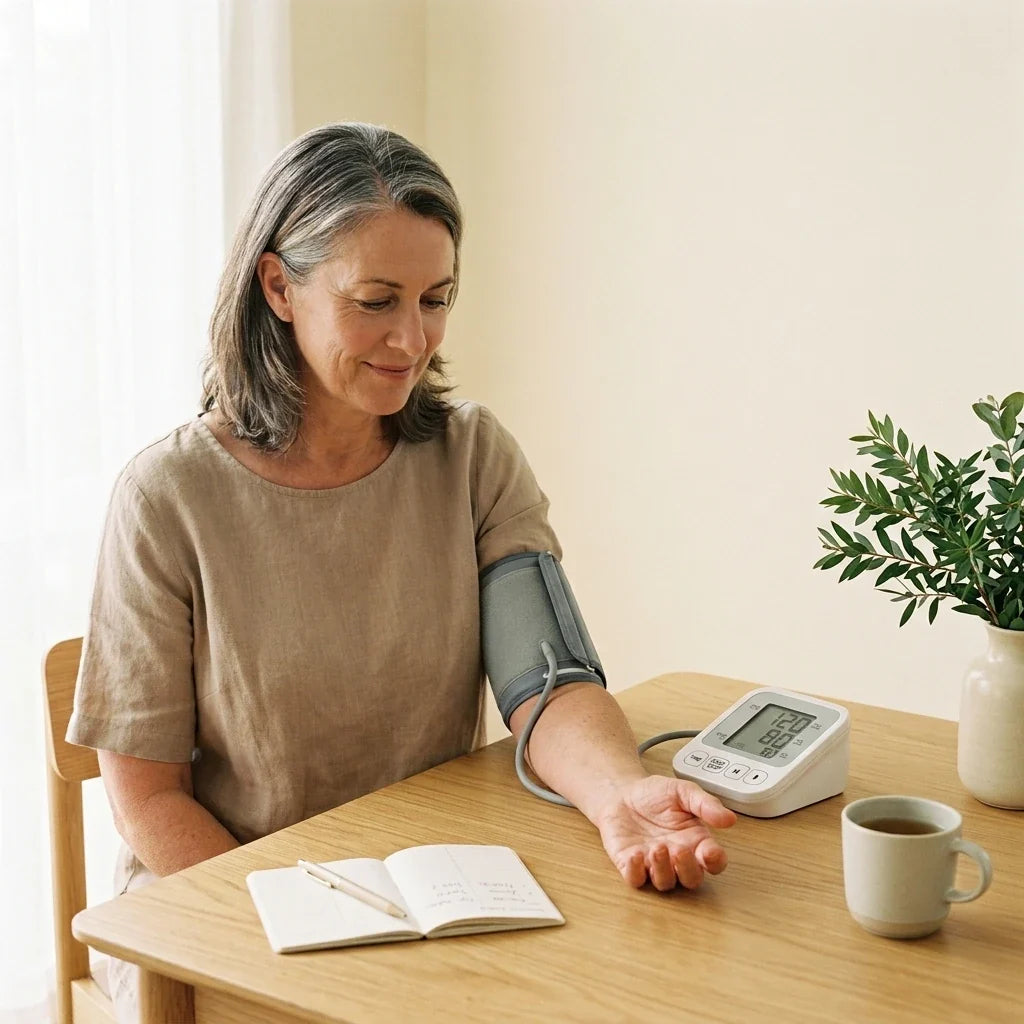
To check your blood pressure at home, sit quietly for five minutes, fit the cuff correctly on your bare upper arm, keep your arm supported at heart level, and stay still while the monitor takes the reading. Take two readings one minute apart and record both. For the most consistent results, measure at around the same time each day — and if your healthcare professional has asked you to monitor your blood pressure at home, follow their advice on how often to measure.
Quick answer — how to measure blood pressure at home:
• Rest quietly for five minutes before measuring
• Sit with your back supported, legs uncrossed and feet flat on the floor
• Place the cuff on your bare upper arm, about two finger widths above your elbow
• Keep your arm relaxed and supported at heart level
• Stay still and don’t talk during the measurement
• Take two readings, one minute apart, and record both
• Use the same arm and similar times each day
• Avoid caffeine, smoking or vaping, alcohol, exercise and hot showers for 30 minutes beforehand
Why check blood pressure at home?
Home blood pressure monitoring can give you a better picture of your blood pressure over time. Some people have higher readings in a clinic or pharmacy because they feel nervous or stressed — sometimes called the “white coat” effect. Measuring at home, when you’re more relaxed, can provide useful readings for you and your healthcare professional.
Regular home measurements can also help you and your healthcare professional understand how your blood pressure changes over several days or weeks, and monitor the effects of lifestyle changes or prescribed medication.
What you need to check your blood pressure
For home monitoring, an automatic upper arm blood pressure monitor is a good choice. The NZ Heart Foundation recommends an upper arm cuff rather than a wrist monitor, and stresses the importance of choosing the correct cuff size — an incorrectly sized cuff can affect the accuracy of your reading.
You’ll also need somewhere to record your results: a notebook or blood pressure logbook, or a Bluetooth blood pressure monitor that automatically stores readings in a smartphone app.
When choosing a home blood pressure monitor, look for:
• An upper arm cuff rather than a wrist cuff
• The correct cuff size for your arm
• A clear, easy-to-read display
• A monitor that is clinically validated
• Memory storage or Bluetooth/app connectivity if you want to track readings digitally
Tip: If you’re unsure whether your monitor is giving accurate readings, take it to your healthcare provider or pharmacy and ask them to compare it with their device.
Step 1 — Prepare 30 minutes before checking your blood pressure
For 30 minutes before taking a reading, avoid smoking or vaping, alcohol, caffeine (coffee, tea and energy drinks), exercise, and hot showers or baths. Use the toilet before measuring — a full bladder can affect your reading.
Step 2 — Sit and rest for five minutes
Sit upright in a chair with your back supported. Keep your legs uncrossed and both feet flat on the floor. Rest your arm comfortably on a table and sit quietly for five minutes before starting your monitor.
Step 3 — Fit the blood pressure cuff correctly
Place the cuff around your bare upper arm — not over clothing — with the bottom of the cuff about two fingers’ width above your elbow. The cuff should feel snug but not uncomfortably tight.
Rest your forearm on the table with your palm facing upwards, keeping the cuff at heart level. Relax your hand and avoid clenching your fist.
Step 4 — Take two blood pressure readings
Press start and remain still and silent while the monitor inflates and deflates. Record your first reading, wait one minute, then take a second reading and record it as well. Use the same arm each time so your readings are comparable.
Step 5 — Record your readings and monitor regularly
Keep a record of your readings, including the date and time. Your healthcare professional can advise how often to monitor and when to take your readings. A Bluetooth blood pressure monitor makes tracking easier by automatically storing each reading, date-stamped, in a smartphone app.
Tip: Take your blood pressure record to your next appointment — a series of readings over time is more useful than a single reading.
What do blood pressure numbers mean?
A blood pressure reading has two numbers, such as 120/80 mmHg (“120 over 80”). The top number (systolic) measures pressure when your heart beats; the bottom number (diastolic) measures pressure when your heart relaxes between beats.
Around 120/80 mmHg or lower is generally considered ideal, but your recommended target can vary — your doctor or nurse can advise what’s right for you. If your blood pressure is 180/120 mmHg or higher, wait five minutes and take another reading. If it remains that high, contact your GP or Healthline promptly, ideally the same day.
Common mistakes that can affect home blood pressure readings
|
Mistake |
Why it matters |
Simple fix |
|
Cuff over clothing |
Fabric changes how the cuff reads |
Bare arm, every time |
|
Arm hanging or unsupported |
Cuff sits below heart level |
Forearm on the table, palm up |
|
Talking or moving |
Movement disturbs the measurement |
Sit still and quiet |
|
Coffee or exercise beforehand |
Both temporarily raise readings |
Wait 30 minutes |
|
One-off readings |
A single number can mislead |
Two readings, same times daily |
|
Switching arms |
Arms can read differently |
Same arm, every time |
Frequently asked questions
How often should I check my blood pressure at home?
If you’re starting out, a common routine is twice a day — morning and evening — for two weeks, then whatever schedule your doctor or nurse suggests. Consistency matters more than frequency: same times, same arm, same routine.
Is a home blood pressure monitor accurate?
A quality automatic upper arm blood pressure monitor, used correctly and with the right cuff size, can provide reliable readings. If you’re unsure about your monitor, take it to a healthcare professional or pharmacy to compare readings.
Which arm should I use to measure blood pressure?
Use the same arm each time for consistent results. If your doctor or nurse recommends a particular arm, follow their advice.
Why is my blood pressure different every time I measure?
Blood pressure naturally changes throughout the day and can be affected by activity, stress, food, caffeine and other factors. Taking two readings one minute apart and tracking them over time gives a more useful picture than a single reading.
Can I check my blood pressure with my phone alone?
No. A smartphone cannot measure blood pressure by itself. However, a Bluetooth blood pressure monitor can send readings to a smartphone app, making it easier to track your results over time.
A reliable monitor makes regular home monitoring simple. Health Marketplace NZ carries a small, well-chosen range of upper arm blood pressure monitors — including Bluetooth models that automatically save readings to an app — with free NZ shipping on orders over $79. You can browse the range on their blood pressure monitors and thermometers collection: healthmarketplace.co.nz/collections/blood-pressure-thermometers
|
A final note: This guide draws on NZ Heart Foundation home-monitoring guidance. It’s general information only — always follow the advice of your own doctor or nurse, and check current guidance as recommendations can change. |


