

|
General information, not medical advice. A pulse oximeter is a wellness monitoring tool — it doesn’t diagnose, treat or cure any condition. If you’re concerned about your breathing or sleep, talk to your GP. In an emergency, call 111. |
Overnight pulse oximetry involves wearing a small pulse oximeter while you sleep so it can continuously record your blood oxygen saturation (SpO₂) and pulse rate throughout the night, rather than taking a single daytime reading.
Wearable and ring-style pulse oximeters measure your oxygen levels every few seconds, store the data, and sync it to a companion app the next morning. This allows you to review your overnight oxygen and pulse trends and, if you choose, share a report with your healthcare provider.
Overnight pulse oximetry can help identify patterns in your oxygen levels while you sleep, but it is not intended to diagnose sleep disorders. If you have symptoms or concerns about conditions such as sleep apnoea, speak with your GP or healthcare provider, who can advise whether a formal sleep study is appropriate.
The quick version
● Overnight pulse oximetry continuously records your SpO₂ and pulse rate while you sleep.
● A healthy adult’s resting SpO₂ is typically around 95–100%, although normal ranges can vary between individuals.
● Many devices display overnight trends and calculate an oxygen desaturation index (ODI), which estimates how often your oxygen level drops during sleep.
● Overnight pulse oximetry is a screening and monitoring tool, not a diagnostic test. A formal sleep study, arranged through your GP or a sleep specialist, is needed to diagnose conditions such as sleep apnoea.
● Wearable and ring-style pulse oximeters are generally more comfortable for overnight use than traditional fingertip clip models.
What is overnight pulse oximetry?
A pulse oximeter uses light to measure two key readings: your blood oxygen saturation (SpO₂), shown as a percentage, and your pulse rate. A daytime spot check provides a single reading at one point in time. Overnight pulse oximetry records these measurements continuously while you sleep, giving you a much clearer picture of how your oxygen levels change throughout the night.
This matters because your body functions differently during sleep. Breathing naturally slows, muscles relax, and some people experience drops in blood oxygen levels—sometimes briefly, sometimes repeatedly. A single daytime reading won’t capture these changes, but overnight monitoring can reveal patterns that may otherwise go unnoticed.
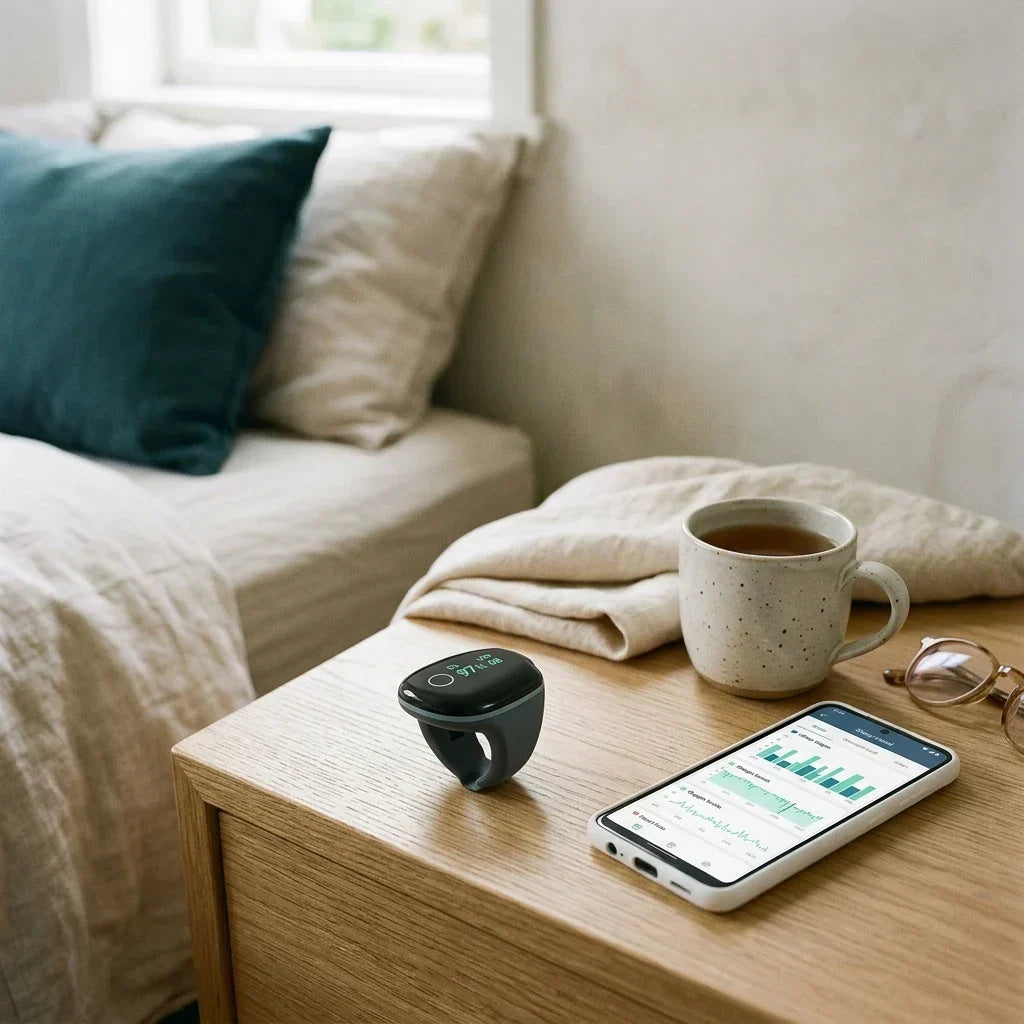
Modern wearable pulse oximeters make overnight monitoring easy at home. Comfortable ring-style and wearable sensors continuously record your SpO₂ and pulse rate, store the data on the device, and sync it to a companion app when you wake. Some models also offer optional vibration alerts that can notify you if your oxygen level falls below a threshold you set.
What the overnight numbers mean
When you review your overnight data, a few key measurements provide the most useful information. The reference ranges below are based on guidance from New Zealand health sources, including Healthify and Health New Zealand | Te Whatu Ora. They are intended to help you understand your results, not to diagnose a medical condition.
● SpO₂ (%) – Your blood oxygen saturation, shown as a percentage. For a healthy adult at rest and at sea level, this is typically 95–100%, although it may dip slightly during normal sleep.
● Average and lowest SpO₂ – Your average oxygen saturation across the night and the lowest recorded value. An isolated low reading may be caused by movement or poor sensor contact, whereas repeated or prolonged drops are generally more meaningful.
● Oxygen desaturation index (ODI) – The estimated number of times per hour your oxygen level falls by a set amount (commonly 3% or 4%) from your baseline. This measurement is often used alongside other information when assessing overnight oxygen patterns.
● T90 – The total amount of time your SpO₂ remains below 90% during the recording.
For context, Healthify notes that an ODI (or the related apnoea–hypopnoea index, AHI) of 5 or fewer events per hour is generally considered within the normal range. Higher values may be classified as mild, moderate, or severe, depending on the result and the clinical context. While many pulse oximeters calculate an ODI, the number should be interpreted by a GP or other healthcare provider, together with your symptoms and medical history, rather than on its own.
Who might find overnight oxygen tracking useful
Many people use overnight pulse oximetry simply to better understand what happens while they sleep. It may be particularly useful for:
● People who snore and want to monitor their overnight oxygen patterns.
● CPAP users who want to track overnight oxygen trends alongside their therapy.
● Active people, travellers, and climbers monitoring oxygen levels at higher altitudes.
● Anyone tracking changes over time who would like objective data to discuss with their GP or healthcare provider.
These are common reasons people choose to use a pulse oximeter—they are not indicators that you have a medical condition. Overnight pulse oximetry is designed to help you monitor and understand your oxygen trends. If you have concerns about your sleep, breathing, or oxygen levels, speak with your GP or healthcare provider, who can advise whether further assessment, such as a formal sleep study, is appropriate.
Can an oximeter diagnose sleep apnoea?
No. An overnight pulse oximeter can be a useful screening tool, but it cannot diagnose sleep apnoea on its own. It may show repeated drops in your blood oxygen levels during sleep, which can be useful information to share with your GP or healthcare provider. However, a diagnosis of sleep apnoea requires a clinical assessment and, in most cases, a formal sleep study.
In New Zealand, the process typically begins with your GP. If they suspect you may have obstructive sleep apnoea, they can arrange a sleep assessment or refer you to a sleep specialist. Depending on your circumstances and local eligibility criteria, some assessments may be publicly funded or subsidised. A home sleep test or an in-lab sleep study measures much more than oxygen levels alone—including breathing patterns, airflow, and other physiological signals—providing the information needed to diagnose sleep apnoea and guide treatment.
|
|
Overnight oximeter (home) |
Home sleep test (Level 3/4) |
In-lab sleep study |
|
What it records |
SpO₂ + pulse (some add movement) |
Oxygen, airflow, breathing effort, pulse |
Brain waves, breathing, oxygen, heart, movement (full) |
|
Where |
Your own bed, any night |
Your own bed, arranged by a clinic |
Overnight in a sleep lab |
|
Arranged by |
You, over the counter |
GP or sleep clinic |
GP referral to a specialist |
|
Best thought of as |
Ongoing tracking & screening |
Diagnostic test |
The most detailed assessment |
|
Gives a diagnosis? |
No — shares data |
Yes, interpreted by a clinician |
Yes, the fullest picture |
The takeaway: A consumer pulse oximeter is best used to monitor and track your overnight oxygen levels—it can help you spot patterns and provide useful information to discuss with your GP or healthcare provider. However, it cannot diagnose sleep apnoea or other sleep disorders. Diagnosis and treatment decisions should always be made by a qualified healthcare professional.
If you snore heavily, wake up gasping or choking, experience pauses in breathing during sleep, or feel excessively sleepy during the day—particularly if you drive or operate machinery—don’t rely on a home monitoring device alone. Make an appointment with your GP, who can assess your symptoms and arrange further testing if needed. The Sleep Apnoea Association of New Zealand (SAANZ) also provides information, education, and support for people affected by sleep apnoea.
How to perform an overnight pulse oximetry check at home
1. Charge the device before going to bed so it has enough battery for a full night’s recording.
2. Fit the sensor correctly. Whether you’re using a ring-style pulse oximeter or a wrist-worn monitor with a ring sensor, make sure it fits snugly without being uncomfortable.
3. Start the recording. Follow the manufacturer’s instructions to begin monitoring before you go to sleep. Most wearable pulse oximeters then record continuously throughout the night.
4. Sync your data in the morning. Open the companion app and sync the overnight recording via Bluetooth to review your oxygen and pulse trends.
5. Monitor for several nights. A single night’s results can be affected by factors such as a cold, alcohol, poor sleep, or an unusual sleeping position. Recording over several nights often provides a more representative picture of your usual overnight oxygen patterns.
6. Share your results if needed. Many wearable pulse oximeters allow you to export a report that you can share with your GP or healthcare provider if you wish.
What can affect your overnight readings?
Home pulse oximetry provides useful information, but the readings can be influenced by a range of everyday factors. Common causes of inaccurate or inconsistent readings include:
● Cold hands or reduced circulation to the finger.
● Nail polish or artificial nails, which can interfere with the sensor.
● A sensor that is too loose or shifts during the night, resulting in poor contact.
● Frequent movement during sleep, which can affect signal quality.
Understanding these factors can help you interpret your overnight data more accurately. An isolated low reading may simply be caused by movement or poor sensor contact, whereas a similar pattern occurring over multiple nights may be more meaningful. If you’re concerned about your results or have symptoms such as loud snoring, pauses in breathing during sleep, or excessive daytime sleepiness, discuss your findings with your GP or healthcare provider.
Choosing a pulse oximeter for overnight use
For all-night monitoring, comfort is one of the most important factors. Traditional fingertip clip pulse oximeters are useful for quick spot checks, but they are not always practical for sleep because they can feel bulky or move out of position during the night. Wearable and ring-style pulse oximeters are designed for greater comfort and continuous overnight tracking.
At Health Marketplace NZ, our pulse oximeter range focuses on comfortable, overnight-friendly designs, including the Finger O₂ Ring for simple and convenient SpO₂ tracking, the Checkme O2 Max wrist monitor with extended battery life and desktop software for generating PDF reports, and a Bluetooth ring monitor that combines everyday convenience with continuous overnight monitoring.
These devices connect with free iOS and Android apps for reviewing your overnight trends. Selected models also support Windows and Mac software, making it easier to view and share reports with your GP or healthcare provider.
|
Ready to see how your oxygen holds up overnight? Explore our pulse oximeters — wearable and ring monitors for continuous overnight SpO₂ tracking, with free NZ shipping over $79. |
Frequently asked questions
What is overnight pulse oximetry?
Overnight pulse oximetry involves wearing a small pulse oximeter while you sleep so it can continuously record your blood oxygen saturation (SpO₂) and pulse rate throughout the night, rather than providing just a single daytime reading. You can review your overnight trends in an app the following morning.
What’s a normal blood oxygen level while sleeping?
For a healthy adult, SpO₂ is usually around 95–100% at rest and may dip slightly during normal sleep. Normal ranges can vary between individuals, so this is a general guide rather than a diagnosis. If a reading doesn’t match how you feel, or you’re concerned, contact your GP or healthcare provider, or call Healthline on 0800 611 116.
Can a pulse oximeter detect sleep apnoea?
A pulse oximeter can help identify patterns such as repeated drops in oxygen levels during sleep, but it cannot diagnose sleep apnoea on its own. Diagnosis requires assessment by a healthcare professional and usually involves a sleep study arranged through your GP. Your device report may provide useful information to discuss during your appointment.
What is the oxygen desaturation index (ODI)?
The oxygen desaturation index (ODI) estimates how many times per hour your oxygen level drops by a set amount (commonly 3% or 4%) from your baseline during sleep. Healthify notes that an ODI or apnoea–hypopnoea index (AHI) of 5 or fewer events per hour is generally considered within the normal range, while higher values are interpreted according to clinical guidelines and individual circumstances.
Do I need a prescription to buy an overnight oximeter?
No. Consumer wearable pulse oximeters can generally be purchased without a prescription for personal monitoring and tracking. They are designed to provide information about your oxygen trends but are not a replacement for professional medical assessment.
How many nights should I record?
Recording over several nights can provide a more representative picture than a single night, as results can be affected by factors such as a cold, alcohol consumption, disrupted sleep, or other temporary changes.
|
General information, not medical advice. A pulse oximeter is a wellness monitoring tool — it doesn’t diagnose, treat or cure any condition. If you’re concerned about your breathing or sleep, talk to your GP. In an emergency, call 111. |


